
Test Card Payment Methods
Learn how to use PayNearMe's sandbox test cards to simulate successful transactions, trigger specific decline codes, and validate AVS failure scenarios across the Consumer Portal, Embedded Client, and API.
Overview
When testing your PayNearMe integration in Sandbox, it’s important to use the designated test accounts rather than real payment details. PayNearMe provides a set of sample credit and debit cards that allow you to simulate both successful and declined transactions across the Consumer Portal, Embedded Client, and API. These test credentials make it possible to validate payment flows, verify error-handling logic, and reproduce specific decline scenarios—ensuring your integration is reliable before moving into production.
Consumer Portal Testing
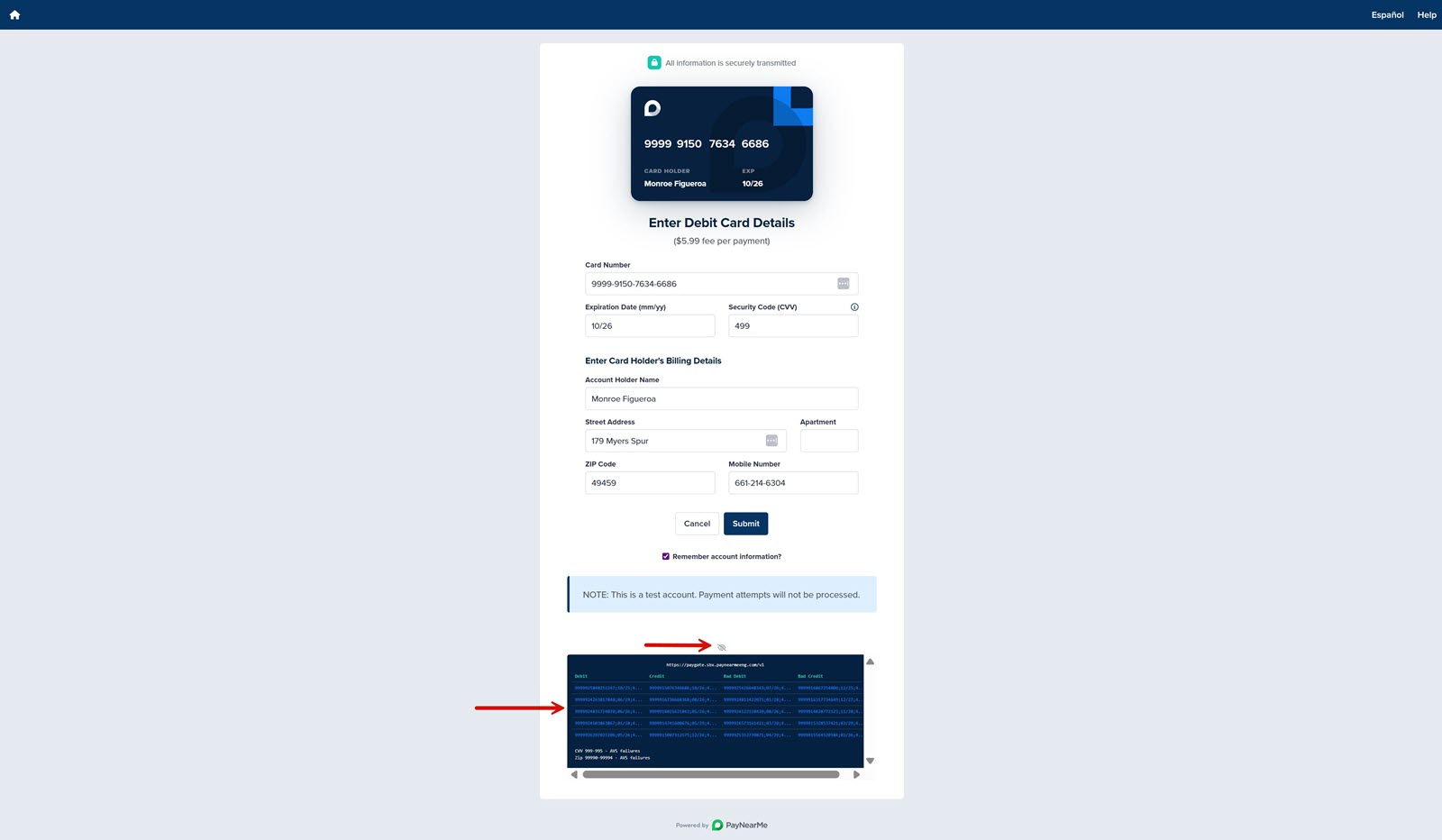
PayNearMe provides test credit card, debit card, and bank account details in the Consumer Portal and Embedded Client that you can add by clicking the View button and then selecting one of the provided values. The portal automatically pre-fills the required payment method data to test both successful and declined transactions.
API Testing
When testing in the API you can use the following card PANs to simulate successful transactions in the PayNearMe platform. All other required fields can be of your choosing as long as they're submitted in a valid format.
| Payment Method Type | Test Accounts |
|---|---|
| Debit Cards | Use the following account numbers in the payment_method_card_number_pii parameter:
|
| Credit Cards | Use the following account numbers in the payment_method_card_number_pii parameter:
|
Decline Testing
When testing decline scenarios you can use the test accounts listed above with the following amounts to simulate specific decline codes. These amounts should be inclusive of the convenience fee for the transaction. The following table includes links to each decline code that can be tested.
| Network Code | Decline Message | Amount |
|---|---|---|
| 05 | This card is not permitted to make this payment. | 213.89 |
| 12 | This payment with this card is invalid. | 213.83 |
| 14 | This card number is invalid. | 213.79 |
| 51 | There are insufficient funds on this card to complete this payment. | 213.73 |
| 54 | This card is expired. | 213.71 |
| 57 | This card is not permitted to make this kind of payment. | 213.67 |
| 61 | This payment exceeds this card’s withdrawal limit. NOTE: This message only occurs with disbursement transactions. | 213.61 |
| 62 | This card is restricted and cannot make this payment. | 213.59 |
| NZ | This payment didn't complete because the security code was invalid. | 213.53 |
| P9 | Unable to process this payment. Please try a different payment method. | 172.01 |
| 20 | Unable to process this payment right now. Please try again later or use a different payment method. | 172.03 |
| 60 | This payment could not be authorized. Please contact your card issuer or try a different payment method. | 172.04 |
| 68 | Unable to receive response from card issuer. Please try again in a few minutes. | 172.05 |
| 6P | The security information could not be verified. Please check your card information and try again. | 172.06 |
| SG | Account could not be found. Please check your card information or try a different payment method. | 172.07 |
| 10 | Unable to process this payment for the requested amount. Please try a different payment method. | 172.02 |
| 9G | Your bank didn’t approve this transaction. Please review your account settings or contact your bank. | 44.02 |
| 5C | Your bank couldn’t approve this transaction. Please contact your bank for more information. | 44.01 |
AVS Testing
AVS testing can be performed using specific CVV values that will trigger decline codes associated with AVS failures.
Updated 2 months ago